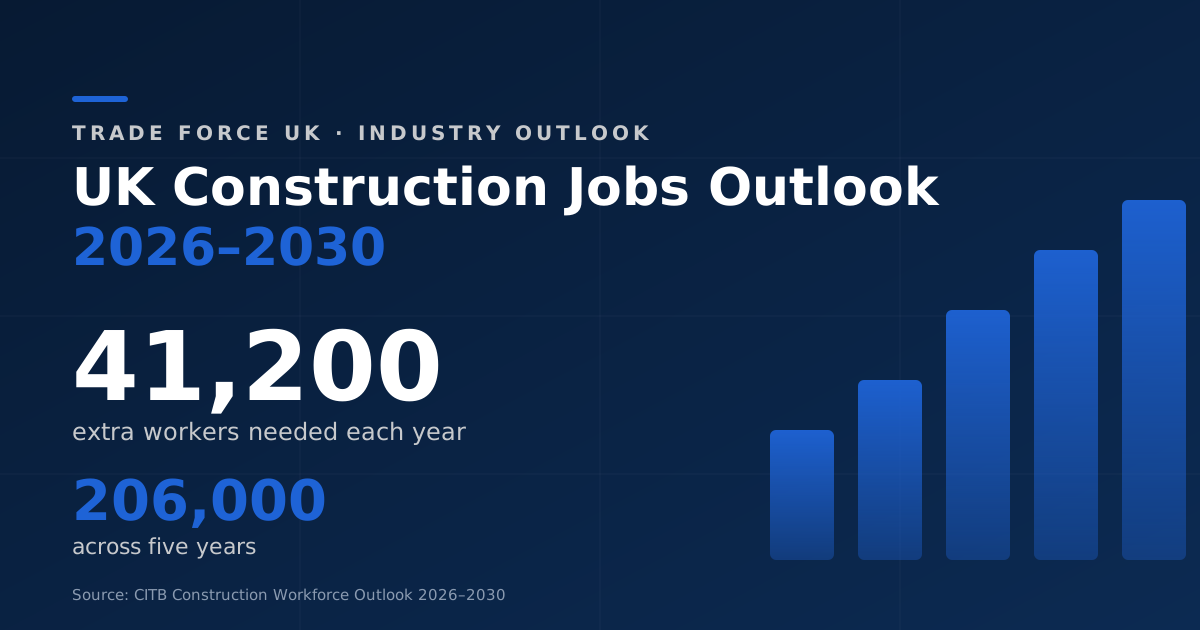
The immediate UK construction market is mixed — output dipped in May 2026 and CITB expects 2026 as a whole to be flat at best. The five-year picture is very different. CITB forecasts that UK construction will need an average of 41,200 extra workers every year between 2026 and 2030 — roughly 206,000 over five years. The practical implication for both contractors and workers is simple: the time to get ready is before that demand arrives, not after.
This article sets out what the official forecasts actually say, where the growth is expected, why contractors are still under pressure right now, and what workers and construction businesses can usefully do about it.
Key facts at a glance
- 41,200
- Extra workers needed on average each year from 2026 to 2030
- 206,000
- Extra workers needed across the five years in total
- 2.68 million
- Forecast size of the UK construction workforce by 2030
- −0.2%
- Forecast change in construction output during 2026, before growth returns from 2027
- 1.8%
- Average annual construction-output growth forecast between 2026 and 2030
- Leading forecast sectors
- Public new housing – approximately 3.6% a year Infrastructure – approximately 2.5% Private new housing – approximately 2.5%
Source: CITB Construction Workforce Outlook 2026–2030
What Is the UK Construction Jobs Outlook for 2026?
Anyone telling you UK construction is booming right now is reading the wrong numbers — and so is anyone telling you it is collapsing. The honest answer depends on the timeframe.
The Office for National Statistics (ONS) estimated that total construction output in Great Britain grew by 1.6% in the three months to May 2026. Within that period, new work grew by 1.1% and repair and maintenance by 2.1%, with non-housing repair and maintenance up 3.0% — the strongest performer. Yet in May 2026 alone, monthly output fell by 0.8%.
Both figures are true at once. Monthly data is volatile, which is why the three-month trend is the better guide to direction — and a positive quarter containing a negative month tells you the market is uneven: some firms and regions are busy while others are quiet.
CITB expects 2026 as a whole to be slightly negative, with construction output forecast to fall by around 0.2% before returning to growth from 2027. So the near-term jobs market is competitive rather than easy. The reason the outlook still matters is what comes next: CITB forecasts average output growth of around 1.8% a year between 2026 and 2030, and that work will need people who, on current recruitment trends, are not yet in the industry.
Why Does UK Construction Need 206,000 Workers?
The 206,000 figure comes from CITB’s Construction Workforce Outlook 2026–2030, and it is worth being precise about what it means, because it is regularly misquoted.
It is not a forecast of 206,000 brand-new permanent jobs. CITB forecasts that the total workforce will grow by around 75,400 between 2025 and 2030, reaching roughly 2.68 million. The recruitment requirement is much larger than the net growth because construction constantly loses people — workers retire, change industry or leave the UK labour market — and every one of them has to be replaced before the workforce can grow at all.
So the 41,200-a-year figure combines two things:
- Growth demand — new roles created by rising output in housing, infrastructure and repair work.
- Replacement demand — filling the gaps left by people who leave the industry each year.
There is a third complication the headline number hides: mismatch. Recruitment demand is not spread evenly by trade or by region. An employer in the North West can struggle for weeks to find a steel fixer or an experienced dryliner while suitable workers sit under-used in another part of the country — or in the same city, unregistered and invisible to the firms hiring. In our experience, this mismatch, rather than a simple absence of people, is what a labour shortage actually feels like on the ground. We covered the structural causes in more depth in our earlier article on the UK construction worker shortage.
Where Is UK Construction Activity Expected to Grow?
CITB forecasts growth across all main sectors over the medium term, but the pace varies considerably. The forecast leaders between 2026 and 2030 are:
Public new housing — about 3.6% a year
The fastest-growing forecast sector, supported by planning reform and public investment in affordable and social housing programmes.
Infrastructure — about 2.5% a year
Energy, utilities, transport and water schemes form a large share of the forecast pipeline, spread across every UK region.
Private new housing — about 2.5% a year
Forecast to recover through the period as conditions improve, feeding demand for groundworkers, bricklayers and finishing trades.
Repair, maintenance & refurbishment
Already a large share of UK output. ONS data shows repair and maintenance outperforming new work in the three months to May 2026.
Two caveats matter. First, growth will vary by sector, region and year — a strong national forecast does not mean every site in every town gets busier at once. Second, forecasts describe the most likely path based on current plans and funding, not a guarantee. Used directionally, though, they tell workers and contractors where labour demand is most likely to concentrate — which is exactly what planning needs.
Why Contractors Are Still Under Pressure
A growing medium-term forecast does not pay this month’s invoices, and the current data shows how hard the trading environment remains. The Insolvency Service reported 3,805 construction-company insolvencies in England and Wales in the 12 months to June 2026 — 17% of all insolvencies where an industry was recorded, the largest share of any sector.
That figure needs careful reading. It covers England and Wales only, over the 12 months ending June 2026, and industry classification is based on the SIC codes companies record at Companies House. It emphatically does not mean 17% of UK construction firms went under — construction is one of the country’s largest industries by company count, so it naturally accounts for a large share of insolvencies. But it does confirm that margins remain tight and that cash flow, cost pressure and programme delays are still ending businesses.
From a recruitment standpoint, the pressures we see contributing most often to wasted money on site are practical rather than macroeconomic:
- Hiring too late. Requirements submitted days before start date force firms to take whoever is free, at whatever rate, with less time for checks.
- Inaccurate labour forecasts. Ordering four operatives when the programme needs six — or needs them two weeks earlier — creates gaps that cost more to fix than to prevent.
- Paying for downtime. When one critical trade is missing — the steel fixer before a pour, the dryliner before decoration — other trades stand around on the clock.
- Compliance discovered on day one. A worker arriving without a valid CSCS card or Right-to-Work evidence loses you the shift and restarts the search.
- Replacing unreliable workers. A no-show costs the day; a poor hire costs the day plus the time to find, brief and mobilise a replacement.
None of this is financial advice — it is an observation from handling staffing requests: most labour cost blowouts we see are process failures, and process failures are fixable. Our guide to building a construction labour pipeline covers the planning side in detail.
The Difference Between an Available Worker and a Site-Ready Worker
“Available” means someone answers the phone. “Site-ready” means they can walk through the gate on Monday and get signed in without a problem. The gap between the two is where placements fall apart.
A genuinely site-ready profile includes:
- An accurate trade and an honest account of experience;
- Location and a realistic travel area — not “anywhere”;
- Whether you have your own transport;
- Current availability, kept up to date;
- A current CSCS or equivalent competency card for your trade;
- Qualifications and role-specific tickets (CPCS or NPORS for plant, for example);
- Right-to-Work information ready to verify;
- Readable copies of documents, with expiry dates visible;
- A phone number that actually gets answered.
When a contractor calls us needing a groundworker for Wednesday, the workers who get the call are the ones whose profile answers every question in that list without a chase. If you are unsure which card applies to your trade, our CSCS card guide explains the types, and our guide to Right-to-Work checks in construction covers what documents are accepted.
Which Construction Workers Should Prepare for Future Demand?
CITB’s occupational tables spread the recruitment requirement across virtually every site role, so this is not a case of one golden trade. In absolute numbers, CITB forecasts some of the largest annual recruitment needs for labourers (around 3,900 extra workers a year) and carpenters and joiners (around 3,000 a year), while steel and metal workers are forecast to see among the strongest annual growth rates of the construction-specific occupations.
Based on the CITB forecast sectors and what we see in day-to-day requirements, the roles worth keeping ready for future demand include:
- Groundworkers and civil engineering operatives — first on site for housing and infrastructure alike;
- Labourers with current CSCS cards — the largest single recruitment requirement in the CITB tables; see our CSCS labourer jobs page;
- Bricklayers and masons, carpenters and joiners — core housing trades on both public and private schemes;
- Dryliners and plasterers — finishing demand follows every completed frame;
- Steel fixers and steel and metal workers — concrete-frame and infrastructure work;
- Plant operators, plant mechanics and fitters — earthmoving and lifting across every growth sector;
- Electricians, plumbers and HVAC trades — building services across new build and refurbishment;
- Scaffolders — access requirements scale with everything else;
- Supervisors — experienced trades who can run a gang remain consistently hard to source.
To be clear: this is not a promise that every trade above is hiring in every region today. Demand depends on trade, location, project mix and timing. What the forecast supports is the narrower claim that recruitment need across these occupations is expected to persist through 2030 — you can see the full range on our trades we cover page.
What Construction Workers Can Do Now
If you want to be in position when demand picks up, the preparation is unglamorous and mostly free:
- Update your CV with your trade, recent sites and the type of work you did;
- Check your CSCS card and any tickets — note the expiry dates and renew early;
- Get your Right-to-Work information together before anyone asks for it;
- Upload readable photos or scans of your documents wherever you register;
- Set a realistic travel limit and say whether you have transport;
- Keep your phone number and email current — placements are lost to dead numbers every week;
- Update your availability promptly when it changes;
- Register with a construction-specific recruitment company rather than a general agency.
You can register with Trade Force UK free of charge in a few minutes. To be straightforward about what that does: registering does not guarantee a job. It puts your details in front of our team so we can review them and consider you when suitable client requirements come up in your area. For a fuller walkthrough of the whole process, read our guide on how to get construction work in the UK.
How Contractors Can Reduce Construction Labour Risk
On the hiring side, most of the risk reduction happens before anyone picks up a phone:
- Submit labour requirements as early as the programme allows — weeks ahead beats days ahead every time;
- Give accurate trade and headcount numbers, including when each trade is actually needed;
- Separate mandatory tickets from nice-to-have experience so the search targets the right pool;
- Provide location, shift pattern, rate and expected duration up front;
- Verify cards and Right-to-Work documents before mobilisation day, not on it;
- Keep a backup option for critical trades rather than relying on a single name;
- Communicate programme changes quickly — a two-day slip you flag early is manageable;
- Use a construction-specific recruitment pipeline instead of starting from a blank sheet each project.
If you have a requirement coming up, you can tell us what you need and we will come back to you within one working day. For ongoing or multi-site requirements, our construction labour hire service covers short-notice and longer-term supply.
How Trade Force UK Supports Workers and Contractors
Trade Force UK is a UK construction recruitment agency — construction is the only sector we work in. We take worker registrations and contractor enquiries from across the UK, with our strongest initial operational coverage in Greater Manchester and the North West.
For workers, we hold profiles covering trade, location, availability, cards and the documents relevant to site work, and our staff review registrations before matching anyone to a requirement. For contractors, we take staffing requests with the trade, headcount, location, rate and duration, and respond from a register of workers whose details we have already reviewed.
We are deliberately careful about claims. We do not guarantee any worker a job, and we do not guarantee any contractor a worker within a fixed timeframe — availability always depends on trade, location, rate, project and timing. What a construction-only register does give both sides is a head start: the matching starts from reviewed, relevant profiles rather than a pile of unread CVs.
Frequently Asked Questions
How many construction workers will the UK need by 2030?
CITB forecasts that UK construction will need an average of 41,200 extra workers a year between 2026 and 2030 — over 206,000 across the five years. That figure covers both new roles from growth and replacement of workers leaving the industry; the workforce itself is forecast to grow by around 75,400, to roughly 2.68 million.
Is UK construction growing in 2026?
Modestly and unevenly. ONS estimated output grew 1.6% in the three months to May 2026, but monthly output fell 0.8% in May itself, and CITB forecasts 2026 as a whole to be slightly negative (around −0.2%) before growth returns from 2027.
Which construction sectors are expected to grow?
CITB’s forecast leaders to 2030 are public new housing (about 3.6% a year), infrastructure (about 2.5%) and private new housing (about 2.5%), with repair and maintenance already performing strongly in recent ONS data. Growth will vary by region and year.
Which construction trades may see demand?
The CITB forecast spreads recruitment need across most site occupations. The largest absolute annual needs include labourers and carpenters and joiners, with groundworkers, bricklayers, dryliners, steel fixers, plant operators and building services trades all featuring. No single trade is guaranteed work in every region.
What documents do workers need for construction jobs?
Typically a current CSCS or equivalent competency card for your trade, Right-to-Work evidence, any role-specific tickets (such as CPCS or NPORS for plant), and readable copies of qualifications. Keeping expiry dates current matters as much as holding the documents.
How can contractors find reliable construction workers?
Plan requirements early, specify mandatory tickets clearly, verify documents before mobilisation, and work with a construction-specific recruiter that reviews workers before putting them forward. Late, vague requests are the most common cause of unreliable supply.
Does registering with Trade Force UK guarantee a job?
No. Registration is free and lets our team review your details and consider you when suitable client requirements arise. Whether work follows depends on your trade, location, availability and what clients need at the time.
Preparing for the Next Phase of UK Construction
2026 is an uneven year, and nobody serving construction clients should pretend otherwise. But the five-year requirement is substantial and well-documented: on CITB’s forecast, the industry needs to find the equivalent of a mid-sized town’s workforce, every year, for five years.
For contractors, that argues for planning labour earlier and treating supplier relationships as infrastructure rather than an afterthought. For workers, it argues for having a complete, accurate, document-ready profile before the busy period arrives. Trade Force UK can help connect suitable workers with genuine requirements — register for work or enquire about staff and we will take it from there.
Industry sources
- CITB — Construction Workforce Outlook 2026–2030 (Labour Market Intelligence Report, United Kingdom report). Published 2026. Accessed 28 July 2026.
- Office for National Statistics — Construction output in Great Britain: May 2026. Published 16 July 2026. Accessed 28 July 2026.
- The Insolvency Service — Commentary — Company Insolvency Statistics, June 2026. Published 17 July 2026. Accessed 28 July 2026.
Related reading: UK Construction Worker Shortage · Why Contractors Need a Labour Pipeline · How to Get Construction Work in the UK · CSCS Card Guide UK